

Email vs. SMS Marketing: Is There a Winner?
Email vs. SMS marketing compared: open rates, conversion, engagement, and cost. Learn when to use each channel and how they work together.
Every ecommerce brand eventually asks the same question: should we invest in email or SMS?
Email has been the default for years — and the data shows it’s still getting better. SMS is the fastest-growing marketing channel, up 40% year over year. Both drive revenue, but they work in fundamentally different ways.
Using 2025 data from 150,000 ecommerce brands¹, here’s how the two channels actually compare across engagement, revenue, and cost — and where the real opportunity sits.
Email vs. SMS marketing
Let’s break down the key areas that matter to marketers:
Opt-ins
Both channels require a list of subscribers who have opted in. Buying lists is not recommended in either case. Email purchased lists are constrained by the CAN-SPAM Act. For SMS, the Telephone Consumer Protection Act (TCPA) makes it illegal to send marketing messages without express consent — and violations carry fines of $500 to $1,500 per unsolicited message.
One thing many brands assume is that people won’t subscribe to SMS. The data says otherwise: 54% of consumers want to receive promotions via text, yet only 11% of businesses send them. For email, 61% of consumers want weekly promotional emails. Willingness is high on both sides.
Winner: Draw — both require opt-in, and consumers want both.
Open and conversion rates
Open rates for both text and email represent your reach. The 2026 Ecommerce Marketing Report¹ — analyzing 150,000 brands, 27 billion emails, and 321 million SMS messages sent in 2025 — gives us an apples-to-apples comparison:
| Metric | SMS | |
|---|---|---|
| Open rate | 30.7% | 98% |
| Click-to-conversion rate | 9.0% | 0.97% |
| Average read time | Hours | Minutes |
Email open rates have been climbing for five consecutive years (30.7% in 2025, up from 26.6% in 2024), and click-to-conversion jumped 53% year over year to 9.0%. But those conversion numbers only measure people who already clicked — a highly engaged subset.
SMS has dramatically higher reach. With a 98% open rate and 95% of messages read within 3 minutes, the attention advantage is structural. SMS click rates more than doubled year over year in 2025. The click-to-conversion rate (0.97%) is lower than email’s, but that’s because SMS reaches nearly everyone — not just the subset who chose to open and engage.
At AudienceTap, text-to-buy campaigns — where customers reply to purchase with no link or checkout — convert at 2% to 6.5% depending on the industry and offer. That’s total conversion (orders per message sent), not click-to-conversion. For a deeper breakdown of SMS marketing statistics including revenue per message benchmarks, see our full analysis.
Response time is also faster for SMS. On average, it takes someone 90 seconds to respond to a text and about 90 minutes to respond to an email.
Of course, the main caveat is that you send effective messages. It doesn’t matter which channel you use: you won’t get results if your messages aren’t engaging or don’t appropriately target the audience.
Winner: SMS marketing
Revenue per message
Open rates and conversion rates only tell part of the story. What matters most to ecommerce brands is how much revenue each message generates¹:
| Channel & Type | Revenue Per Send |
|---|---|
| Email campaigns | $0.18 |
| SMS campaigns | $0.15 |
| Email automations | $2.87 |
| SMS automations | $0.74 |
| Text-to-buy drops | $2.01 |
On a per-message basis, email campaigns ($0.18) and SMS campaigns ($0.15) are nearly identical. The real gap opens up with automations — behavior-triggered messages that arrive when the customer is already thinking about you. Email automations generate $2.87 per send (16x campaigns), while SMS automations generate $0.74 per send (5x campaigns).
Why is email’s automation advantage so much larger? Because even automated SMS still relies on links to checkout pages. The urgency advantage of SMS narrows once the customer lands on the same checkout flow they’d reach from an email.
Text-to-buy changes that equation. At $2.01 per message, text-to-buy drops outperform both email and SMS campaigns — and approach email automation revenue — by removing the checkout entirely. The customer replies to buy. No link, no cart, no friction.
Post-purchase order bumps take it further: $7.39 per message at a 26.2% conversion rate. And rollover campaigns — where customers who missed a sold-out product are offered an alternative — generate $16.02 per message at 37.2% conversion. These secondary campaigns work because the customer never leaves the text thread and their payment is already on file.
Winner: Email for automations (for now). Text-to-buy closes the gap.
Audience profile
Email usage is widespread across all age groups in the United States, with only a slight decline among consumers 65+. It remains one of the most common digital communication tools for both businesses and consumers.
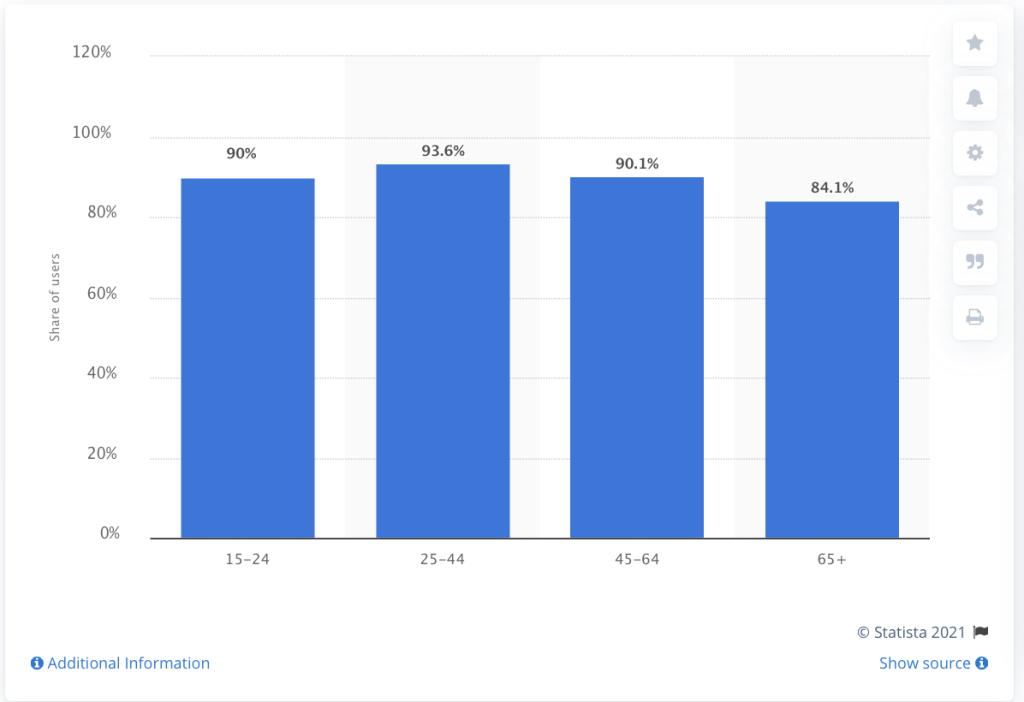
For text messaging, 91% of teens who have cellphones actively text, while adults under 45 send and receive 85+ text messages per day on average. Text is the most-used form of communication among all American adults below age 50. Adults 55+ send and receive 16 texts per day, while it is estimated one quarter of those over 65 use text messaging.
Winner: It depends on your target demographics, but both are popular.
When to use each channel — and when to use both
The data above tells you how each channel performs. The real strategic question is when to use each one. The answer depends on what you're trying to accomplish.
Use email when:
- You need visuals or storytelling. Email gives you the space for product photography, lifestyle imagery, and rich layouts that SMS can't deliver.
- You're educating. Product guides, how-to content, behind-the-scenes stories, and brand journalism all need room to breathe.
- You're launching something genuinely new. If you're a coffee roaster launching an espresso machine — something outside your core category — email gives you the space to explain what it is, why you made it, and why your audience should care. (This is different from a new coffee variety, where your subscribers already understand the category and can buy with a reply.)
- You're building emotional trust. Welcome sequences, founder stories, and brand-building content create the relationship that makes future SMS offers convert.
Use SMS when:
- Something is urgent. Limited-time offers, drops with capped inventory, flash sales — anything where timing matters and you need the customer to see it now, not six hours from now.
- There's friction to remove. If the goal is a transaction, SMS — especially text-to-buy — is the fastest path from offer to order. No link, no cart, no checkout page.
- The message is transactional. "Here's this week's roast. Reply 1 to grab a bag." That's a text, not an email.
- There's personalization or conversation. Reorder prompts based on a customer's consumption pattern, one-on-one product recommendations, or any message that feels like it's coming from a person — not a brand.
One key test: read your last few SMS campaigns. Do they sound like a text from a friend, or like a marketing email with fewer words? If it's the latter, your unsubscribe rate will keep climbing.
Use both when:
- Carts are abandoned. Hit both channels — email for the detailed reminder with product images, SMS for the urgent nudge.
- You're running a launch sequence. Build anticipation with email (the story, the visuals, the "why"), then use SMS to drive the actual purchase when the product goes live.
- You're offering VIP early access. Give your SMS subscribers first-to-know access, then open the launch to your full email list. This rewards your most engaged customers and creates a reason to be on both lists.
- You're onboarding or retaining subscribers. Subscription onboarding, reorder reminders, and retention flows benefit from the depth of email and the immediacy of SMS working together.
The goal isn't to duplicate the same message across both channels. It's to use each channel for what it does best — email for context and storytelling, SMS for action and urgency — and layer them in the moments where both add value.
Winner: The brands using both channels intentionally, not interchangeably.
Challenges of each channel
One of the major challenges for email is getting the attention of your subscribers. Ecommerce brands alone sent 27 billion emails in 2025¹. When you account for all email across every industry, inboxes are overwhelmingly crowded. People have become accustomed to tuning out promotional emails as a result.
Another factor impacting email reach is the efforts of email platforms to separate out emails for their users. Legitimate emails end up in spam folders, or you might find your email goes to the “promotions” tab in Gmail, where it is less visible. The good news: email open rates have been climbing for five consecutive years, suggesting that brands are getting better at earning attention — but the competition for inbox space is only intensifying.
SMS doesn’t have the same challenges with reach — yet. With 321 million ecommerce SMS messages sent in 2025 (compared to 27 billion emails), the channel is still uncrowded. SMS volume is growing fast though — 40% year over year — so the window of low competition won’t last forever. Spam texts are a creeping issue, and carrier filtering is getting more aggressive, which means compliance and sender reputation matter more than ever.
The bigger challenge for SMS has traditionally been getting conversions on mobile. Shopping on a small screen, navigating product pages, and completing multi-step checkouts creates friction that leads to high drop-off rates. Text-to-buy removes this problem entirely — the customer replies to the text to purchase. No website, no cart, no mobile checkout friction. And because text-to-buy layers on top of existing SMS programs, brands don’t have to replace their current stack to capture this revenue.
Winner: SMS — but the gap may narrow as the channel grows.
Cost
With SMS, you pay for every message sent. Email pricing is typically tiered by list size, with many platforms offering a free tier. That makes email cheaper on a per-send basis and more forgiving when you’re experimenting with targeting.
But cost per send is only half the equation — revenue per send matters more. Email campaigns generate $0.18 per send. SMS campaigns generate $0.15. The difference is negligible. Where SMS pulls ahead is when you remove the link: text-to-buy drops generate $2.01 per send, and the cost of the message is a fraction of that return.
Winner: Email on cost per send. SMS on return per send — if you use it right.
Final thoughts
Is there a winner for SMS marketing vs. email? You might expect us as an SMS marketing provider to declare text the winner, but I’m not going to do that. The 2025 data makes it clear that both channels have distinct strengths:
Email wins at: nurturing and complex messaging, automation revenue ($2.87/send for triggered messages), and click-to-conversion among engaged subscribers (9.0%). Email automations represent just 2% of sends but generate 30% of total email revenue¹ — that efficiency is hard to beat.
SMS wins at: reach and immediacy (98% open rate, 95% read in 3 minutes), urgency-driven offers, and pure attention. SMS volume grew 40% year over year in 2025, and click rates more than doubled.
Text-to-buy changes the math: When you remove the link and let customers purchase inside the text thread, SMS revenue per message ($2.01) approaches email automation levels — and post-purchase order bumps ($7.39/message) and rollover campaigns ($16.02/message) surpass them.
The smartest brands aren’t choosing one channel over the other. They’re using email for education, storytelling, and long-form nurturing — and SMS for action. The question isn’t which channel is better. It’s whether your SMS program is doing more than just sending links.
¹ Source: Omnisend 2026 Ecommerce Marketing Report — analysis of 150,000 brands, 27 billion emails, and 321 million SMS messages sent in 2025.
AudienceTap is a text-to-buy platform that lets customers purchase products by replying to a text message — no links, no carts, no checkout pages.
With reply-to-buy purchasing, AI-timed replenishment drops, abandoned cart recovery, and list growth tools, AudienceTap turns SMS from a traffic channel into a sales channel. Brands on the platform average $2.01 in revenue per message and 5.5% conversion rates on drops.
Talk to a text-to-buy expert to see what your SMS revenue could look like.